Friday, October 30, 2015

MARY OF NAZARETH - PROMISED BY GOD, PROPHESIED IN THE OLD TESTAMENT, UNIVERSALLY BLESSED TODAY


THE HISTORY OF MARY OF NAZARETH GOES RIGHT BACK TO THE BEGINNING OF HUMAN HISTORY; IN GENESIS 3;15, GOD PROMISED THERE WOULD BE A WOMAN WHOSE OFFSPRING WILL BE AT ENMITY WITH SATAN.
'And I will put enmity between you and the woman, and between your offspring and her offspring; He shall crush your head, and you will bruise His Heel'

The Old Testament prophesies of Mary;
Jeremiah 31;22; 'The LORD will create a new thing on earth - a woman shall encompass a man'

Isaiah 7;14; 'Therefore the LORD Himself will give you a sign.The virgin will conceive and give birth to a son, and will call him Immanuel'

Psalm 22;9-10 'Yet you brought me out of the womb;
you made me trust in you, even at my mother's breast.
From birth I was cast on you;
from my mother's womb you have been my God'

Micah 5;2-3 'But you, Bethlehem Ephrathah,
though you are small among the clans of Judah,
out of you will come for me
one who will be ruler over Israel,
whose origins are from of old,
from ancient times'

Mary in the New Testament
Matthew 1;16; '...and Jacob the father of Joseph, the husband of Mary, and Mary was the mother of Jesus Who is called the Messiah'

Luke 1;26-56. God sent the Archangel Gabriel to Mary in Nazareth. He named Mary blessed, and told her the news that she would become pregnant with the Son of the Most High, Jesus.
Jesus would receive the throne of King David, his ancestor; His rule would be an eternal one.
Mary went to visit her pregnant cousin Elizabeth, and spoke the prophetic words of Mary's song. Particularly poignant and true of Our Blessed Lady is when she proclaimed, 'From now on all generations will call me blessed' [Luke 1;48].

Luke Chapter 2; Mary went with Joseph to Bethlehem to be registered in the census. It was there that Jesus was born.
  When the time for the purification of Mary and the presentation and circumcision of Jesus, they went up to Jerusalem.
  Thereafter Jesus was presented in the Temple, and acclaimed by Simeon and Anna - prophets in the Temple.
  Naturally Jesus was in the arms and the care of his parents, Joseph and Mary. Mary his natural mother, Joseph his earthly stepfather.

Matthew 2;13-14 tells of the Angel's warning to Joseph to flee with Jesus and His mother Mary, to Egypt; thus saving their lives from the assassination plot of the then King, Herod.

Mary is spoken of again in Luke 2;41-51; when she and Joseph searched anxiously for Jesus who had - unknown to them - stayed behind at the Temple in Jerusalem.
  He was discussing theology with the teachers at the Temple. Mary discussed other things with them - such as obedience to His parents.
  Jesus had discovered His true paternity - and, as always happens, familial differences led to the ruffling of the waters of family harmony.
  Mary treasured all these occurrences in her heart - she knew her Son was destined for great things.
  She had received warning from Simeon that a sword of sorrow would pierce her soul - as occurred later at the execution of her Son.

Mary is mentioned in Luke 8;19, when she came to visit Jesus while He was at public ministry.

The people of Nazareth speak of Mary, when they question; 'Is not this the carpenter's son? Is not his mother called Mary?' in Matthew 13;55.

A woman in the crowd praised Mary as blessed to have borne Him. Luke 11;27-28.

The crowds in Capernaum mention Mary, in John 6;42. 'And they said, Is not this Jesus, the son of Joseph, whose father and mother we know?'

Mary stood by Jesus throughout his suffering and death.
She stood at the foot of the cross on which He was crucified.
Jesus entrusted Mary into the care of His beloved disciple, John.
  From then on, Mary's home was with John. [John Chapter 19].

Mary supported the disciples of the Early Church. They were all at prayer in the Upper Room when the Holy Spirit of God came down, as Jesus had promised. [Acts 1;14]

Paul spoke of Mary in the Letter to the Galatians, 4;4. 'But when the fullness of the time was come, God sent forth His Son, made of a woman, made under the law.'

The Book of Revelation speaks of Mary's symbolic appearance as Empress of Heaven, conqueror with her Son over the dragon. She wears a crown of twelve stars, and is a wonder in Heaven. [Revelation 12;1-17].


Breath of Heaven
tps://www.youtube.com/watch?v=kPbV_HTpyx0

With thanks to Youtube


Sunday, October 18, 2015

SAINT FINNIAN OF IRELAND

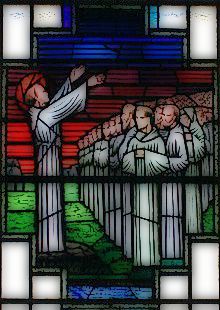
St Finnian and his Pupils - inspired by Stained Glass Window St Finnian Church, Clonard


Powerful man of God
  St Finnian, known as 'The Teacher of the Saints of Ireland', was born around 470 AD.
  This powerful man of God was born at Myshal in County Carlow on the slopes of Mount Leinster.
  It is said that the birds of Ireland gathered as a portent of the holy life he would lead.
  Finnian's father was an Ulsterman of noble lineage, named Rudraigh. His mother was a lady from Leinster named Telach.
  Finnian is also known as Finian, Fionán or Fionnán in Gaelic.
His feast day is celebrated on 12th December each year.

Travelled to France 
  As a young boy Finnian was placed under the care of St Fortchern.
  Finnian eventually travelled to France during the course of his studies.

  Finnian first landed at St Martin's famous monastery at Tours. 
He continued his holy life and devout studies; eventually travelling to Wales.
  In Llancarfan in Glamorganshire, this holy man of God furthered his spiritual studies and practise in the famous Monastery of Cadoc the Wise.
 
Return to Eire
  Eventually Finnian returned to Ireland where he preached, taught and founded churches.
  As he travelled, Finnian spent time at St Brigid's Monastery in Kildare, where he both undertook studies and taught students. 
  Around 520 AD, it is said that Finnian was led by an Angel to Cluain Eraird (Clonard) which he was told would be the place of his resurrection.  
  Upon his departure from Brigid's monastery, she presented him with a gold ring.
  Finnian thus had made the move from official Monastery life into development of a whole new movement at Clonard.

Cell and Church
  Finnian built a little cell and church of clay and wattle in Clonard situated on the River Boyne.
  Eventually this little dwelling gave way to a sturdy and substantial stone structure, imminently suited to the shelter of many as they learned about the Gospel and the values of Jesus Christ.
  As Finnian continued his life of prayer and study, the fame of his depth of learning and sanctity spread abroad.
  Students flocked all around him, including twelve Irishman who studied at Clonard.
  These luminous disciples of Christ and students of Finian became known as the Twelve Apostles of Ireland;
St Ciarán of Saighir, St Ciaran of Clonmacnoise, St Brendan of Birr, St Brendan of Clonfert [Brendan the Navigator], St Columba of Terryglass, St Columba of Iona, St Mobhí of Glasnevin, St Ruadhain of Lorrha, St Senan of Iniscathay, St Ninnidh of Loch Erne, St Laisrén mac Nad Froích, St Canice of Aghaboe.

  These men carried the Gospel Message of Jesus Christ to Ireland, Britain and Europe.
Very famous among them was St Columcille or Columba. 
 
School at Clonard
  The famous monastic school of Finnian at Clonard - known as Clonard Abbey - was the greatest school of the time, known particularly for its biblical studies (Finian was a skilled Biblical scholar).
  The Monastery founded by Finnian flourished until the 12th Century.
  The Office of St Finnian states there were no fewer than 3 000 pupils getting instruction at one time in the green fields of Clonard.
  Finnian - holy in life and quietly humble in suffering - died at Clonard of the yellow plague in about 549-52 AD.

Birds - fact or fiction?
A flock of birds is the sign that St Finnian's spiritual influence is at work.
  Often a flock of birds will fly above the St Finnian's Well area, or above pilgrims making their way to the holy site. 
  Over the years, I have seen flocks of birds circling above the Holy Well upon each of my retreats and pilgrimages to the sacred site.
  Recently I made the trip towards St Finnian's well. As I drove towards the blessed site, I thought to myself that perhaps I had overemphasized the sign of birds I have seen on my pilgrimages to the miraculous well.
  As I finished thinking this, a flock of birds swooped over my car [in the middle of the heat of the day], and one came skimming very low over the top of the car.
  So I leave the description of the sign in this blog post after all ...

Angel's Prophecy
  On one pilgrimage to the Holy Well, I met a wise woman who has lived her whole life in the area. 
  She told me the following story, which has been handed down from generation to generation in her family.
  As a child, her mother used to take her to St Finnian's Well on pilgrimage, and then tie a cloth on the branches near the Well after they had visited and prayed.
  Her grandmother had taken her mother as a young girl; and so on through the generations.
  They had treasured the story, passing the oral tradition down.
Now she is the last of her line, and patiently told me the following tale . . . 

 An Angel attired in blindingly white apparel appeared to Finnian, and bade him follow him.
  He took Finnian to the area where - he was told - he was to build his house and school.
  Then the Angel took him to the place where the present day Well is found.
  The Angel told Finnian that people should come to the Well to ask for God's Grace, for God's blessings, and to ask for their needs and for healing of illness.
  Finnian saw no spring; at that - as a storm raged overhead, with lightning in the heavens - the Angel drove the point of the staff he carried into the ground, and a spring gushed up.
  Finnian fell to his knees, and promised to pass on the Message of God through His faithful Angel to every generation to come.
  Finnian furthermore placed the gold ring on the ground that St Brigid had given him; and the spring water flowed over the blessed metal.

Great Saint
  As the storm abated, the Angel told Finnian he would be known as a great saint and would have an everlasting influence on the people of Ireland.
  The Angel furthermore told Finnian to tell people to bless themselves with the water from the Well, especially when looking for a cure.
  When the Angel left, Finnian went and built his cell and church out of clay and wattle.
  The next time he was travelling past St Brigid's Monastery, he spent the evening telling her what had transpired.
  Finnian showed her the golden ring, and she took the rounded metal over which the spring water had flowed, and kissed the ring with tears in her eyes.
  She sent Finnian on with a blessing, for, she said, although she had wished to keep this holy man of learning and prayer to be a permanent teacher in her Monastery; the sign that had been given had shown clearly that his paths lay elsewhere - on the land where the Angel had guided his steps.

Healings
  Many people have visited St Finnian's Well seeking a cure for their ailments.
  Over the centuries many healings have taken place at this sacred site.
To this day, clear water continually refreshes the well where pilgrims make their way.
  St Finnian is a saint well known for helping people in troubled circumstances and those with health worries.

Holy Well, Place of Pilgrimage
  You can visit the well which quietly waits for pilgrims in a hedgerow.
For centuries St Finnian's Well has been regarded as a Holy Well by the people of Ireland.
  Local tradition has it that St Finnian bestowed a blessing on the people of Clonard that nobody from the area would ever be killed by lightning.
 
Why not visit?
  Why not go on pilgrimage to St Finian's Well if you live in Ireland, or are visiting the Holy Isle?
  The holy man of God continues his healing work from Heaven . . .

Directions to St Finian's Well
http://source.southdublinlibraries.ie/bitstream/10599/10599/3/Newcastle%20Walking%20Tour_3.pdf 


St Finian's Well


With thanks to Southdublinlibraries
Images by Rev Catherine

Marian Wall Shrine, Bari


MARIAN PRAISE READERS WERE REMEMBERED IN PRAYER BEFORE MARIAN WALL SHRINE, BARI


Marian Praise Readers, you have been remembered
in prayer before Marian Wall Shrine near
Basilica di San Nicola in Bari, Italy

Wall Shrine near the Basilica di San Nicola in Bari, Italy

With thanks to Wikipedia

Saturday, September 19, 2015

The Rise of The Oxford Movement and the Pre-Raphaelite Brotherhood in the Nineteenth Century and the Coinciding Renascence of Marian Poetry (Twelve); Alice Meynell


Alice Meynell, the wife of the partnership who sheltered Francis Thompson during his affliction and nurtured his genius, seems to present human beings as trying to conceive of Christ in the mind in her poem:

     TO THE MOTHER OF CHIST, THE SON OF MAN

     We too (one cried), we too,
     We the unready, the perplexed, the cold,
     Must shape the Eternal in our thoughts anew,
     Cherish, possess, enfold.

     Thou sweetly, we in strife.
     It is our passion to conceive Him thus
     In mind, in sense, within our house of life;
     That seed is locked in us.

     We must affirm our Son
     From the ambiguous Nature's difficult speech
     Gather in darkness that resplendent One,
     Close as our grasp can reach.

     Nor shall we ever rest
     From this our task. An hour sufficed for thee,
     Thou innocent! He lingers in the breast
     Of our humanity.
                                             [1-16]

  Meynell's main message posits that, whereas Mary conceived Christ as a mother, in her womb [not intellectually] in what for her was a simple hour [15], humankind makes a lifetime task out of conceiving Christ in the mind.

Dr Luky Whittle

Poet and suffragist
Alice Christiana Gertude Meynell was an English writer, editor, critic and suffragist; now remembered mainly as poet.
  Her first poetry collection was Preludes [1875], and was illustrated by her elder sister - the artist Lady Elizabeth Butler.
  John Ruskin, the leading English art critic of the Victorian era, praised Preludes - in particular, the sonnet 'Renunciation' for its beauty and delicacy.

Faith in Poetry 
 Meynell's writings migrated to subjects of religious matters.
Her "Sœur Monique"  is a serene testament to a woman of faith
  The poet addresses 'Quiet form of silent nun' [1], and speaks of
     'This old master's melody  [6]
      That expresses you;         [7]
  Meynell illuminates the faith-woman's life of prayerful unity with God. The sister is seen standing 
     'With your life held in your hand      [36]
      As a rosary of days                        [37]
  A magnificent image is thus flawlessly word-painted by the poet, whose personal faith was an integral part of her being.

Economy of syntax
The poet created 'Via, et Veritas, et Vita' ; 'I am the Way',
'Unto us a Son is given' and 'Veni Creator'.
  These poems with spiritual titles and text are a clear indication of her faith translating into her creativity.
  The poetry Meynell produced from 1893 to 1902 demonstrated her growing mastery of what one critic named a 'chastened' form.
  She manipulated economy of syntax and rare felicity of expression, within the orthodox sonnet and quatrain.

Madonna Alice
  The poet's spiritual and emotional strength led her to support others in their difficulties.
  She and her husband were deeply supportive of the poet Francis Thompson who was struggling to overcome opium addiction.
  Wilfred and Alice Meynell rescued Thompson from the streets and sent him to a hospital to help him with rehabilitation.
  They supported him both financially and emotionally his entire life.

  Thompson - his wounded body and mind given shelter and peace by the poet and her husband - overcame his disability to produce exceptionally fine poetry.
  Such was the warmth the kindness of the Meynells inspired in Thompson, that he referred to Alice as 'Mother', 'Lady' and even 'Madonna Alice'.
  Francis, the Meynell's last child, was named for his godfather - Francis Thompson.

Women Writers' Suffrage League
  Meynell - a leading figure in the Women Writers' Suffrage League - spoke out courageously on behalf of the oppressed.
  She campaigned for the right of women to vote; and witnessed the success of the suffragette movement in her lifetime.
  The poet was an activist who used her abilities and position in society to reach out to help those in need.
 
  This luminous 'madonna' - sensitive to the needs of others as she struggled with her own series of illnesses, including migraine and depression - continued to pen a library of letters, essays and poetry that stand to this day.

Catherine Nicolette
 
Poet Alice Maynell


"Sœur Monique"
http://poetry.elcore.net/CatholicPoets/Meynell/Meynell006.html

Via, et Veritas, et Vita
http://poetry.elcore.net/CatholicPoets/Meynell/Meynell050.html

I am the Way
http://poetry.elcore.net/CatholicPoets/Meynell/Meynell049.html

Unto us a Son is given
http://poetry.elcore.net/CatholicPoets/Meynell/Meynell053.html

Veni Creator
http://poetry.elcore.net/CatholicPoets/Meynell/Meynell054.html


With thanks to Poetry.elcore.net
Image and Editing by Catherine Nicolette

The Rise of The Oxford Movement and the Pre-Raphaelite Brotherhood in the Nineteenth Century and the Coinciding Renascence of Marian Poetry (Eleven); Francis Thompson


Unlike the other nineteenth-century poets who wrote in praise of the Blessed Virgin Mary mentioned thus far, Francis Thompson [1859-1907], who is probably best known for his Christ poem The Hound of Heaven, was an ardent admirer of seventeenth-century metaphysical poetry.  1
  He suffered poverty and deprivation and was addicted to drugs.
His plight was recognized by the publisher-poet Wilfrid Meynell [1852-1948] and his wife the poetess/essayist Alice Meynell [1847-1922], who not only were the first publishers to publish Thompson's poetry but took the impoverished poet into their home where he remained under their care until his death and where he grew in poetic stature as his writing brought him wide acclaim.

Office of Our Lady 
 Thompson was familiar with the devotion known as 'The Office of Our Lady' and, of course, the Old Testament, including the Canticle of Canticles.  2
  In the poem Assumpta Maria transcribed below, he refers to himself as a poor Thief of song [99], (a clear reference to the thief who  made supplication while being crucified alongside Christ), while in an 1893 letter [Connolly 1979:477]  3  which accompanied certain poems including the one which follows, he wrote:
  They (the sources) are almost entirely taken from the Office of the Assumption, some from the Canticle, a few images are from mythology. Some very beautiful images are from a hymn by St Nerses the Armenian, rendered in 'Carmina Mariana'.
  You will perceive therefore the reason of the motto from Cowley: 'Thou needst not make new songs, but say the old.'

ASSUMPTA MARIA

Thou needs not make new songs, but say the old. -COWLEY

'Mortals, that behold a Woman
Rising 'twixt the Moon and Sun;
Who am I the heavens assume? an
All am I, and I am one.
'Multitudinous ascend I,
Dreadful as a battle arrayed,
For I bear you wither tend I;
Ye are I: be undismayed!
I, the Ark, that for the graven
Tables of the law was made;                                           10
Man's own heart was one; one, heaven; Anteros           4
Both within my womb were laid.
For there Anteros with Eros                                              5
Heaven with man, conjoinéd was
Twin-stone of the Law, Ischyros,                                      6
Agios Athanatos                                                                 7

'I, the flesh-girt Paradises
Gardenered by the Adam new,
Daintied o'er with dear devices
Which He loveth, for He grew.                                         20
I, the boundless strict Savannah                                        8
Which God's leaping feet go through;
I, the heaven whence the Manna,
Weary Israel, slid on you!
He the Anteros and Eros,
I the body, He the cross;
He upbeareth me, Ischyros,
Agios Athanatos!

'I am Daniel's mystic Mountain,
Whence the mighty stone was rolled;                               30
I am the four Rivers' Fountain,
Watering Paradise of old;
Cloud down-raining the Just One am,
Danae of the Shower of Gold;                                              9
I the Hostel of the Sun am;
He the Lamb, and I the Fold.
He the Anteros and Eros
I the body, He the Cross;
He is fast to me, Ischyros,
Agios Athanatos!                                                                 40

'I, the Presence-hall, where Angels
Do enwheel their placéd King-
Even my thoughts which, without change else,
Cyclic burn and cyclic sing.
To the hollow of heaven transplanted,
I a breathing Eden spring,
Where with venom all outpanted
Lies the slimed Curse shrivelling.
For the brazen Serpent clear on
That old fangéd knowledge shone;
I to Wisdom rise, Ischyron,                                               50
Agion, Athanaton!

'Then commanded and spake to me
He who framed all things that be;
And my Maker entered through me,
In my tent His rest took He.
Lo! He standeth, Spouse and Brother,
I to Him, and He to me,
Who upraised me where my mother
Fell, beneath the apple-tree.                                               60
Rise 'twixt Anteros and Eros,
Blood and Water, Moon and Sun,
He upbears me, He Ischyros,
I bear Him, the Athanaton!'

Where is laid the Lord arisen?
In the light we walk in gloom;
Though the Sun has burst his prison,
We know not his biding-room.
Tell us where the Lord sojourneth,
For we find an empty tomb.                                                70
Whence He sprung, there he returneth,
Mystic Sun, - the Virgin's Womb'
Cloud-enpillared as He was
From of old, there He, Ischyros,
Waits our search, Athanatos.

Who is She, in candid vesture,
Rushing up from out the brine?
Treading with resilient gesture
Air, and with that Cup divine?
She in us and we in her are                                                   80
Beating Godward: all that pine,
Lo, a wonder and a terror -
The Sun hath blushed the Sea to wine!
He the Anteros and Eros,
She the Bride and Spirit; for
Now the days of promise near us,
And the Sea shall be no more.

Open wide thy gates, O Virgin,
That the King may enter thee!
At all gates the clangours gurge in,                                      90
God's paludament lightens, see!                                           10
Camp of Angels! Well we even
Of this thing may doubtful be, -
If thou art assumed to heaven,
Or is heaven assumed to thee!
Consummatum. Christ the promised                                     11
Thy maiden realm, is won, O Strong!
Since to such sweet Kingdom comest,
Remember me, poor Thief of Song!
Cadent fails the stars along:-                                               100
Mortals, that behold a woman,
Rising 'twixt the Moon and Sun;
Who am I the heavens assume? an
All am I, and I am one.

Greek usage
There is a ring of triumph about this poem, and the use of Greek expressions and poetic devices bestows a sense of victory on the poet's poetic celebration of the Blessed Virgin Mary.
  The fact that the Greek is fairly obscure to the general reader of our era, from whose school curriculum at first classical Greek and later classical Latin have largely been dropped, adds to the aura of scholastic formidability of the poet who pens them with a nonchalance which contrasts with the magnificence of their thunderous quality.
  Like Newman and Hopkins, though in his own individual way, Thompson in his Marian poetry shows the era's intellectual approach to the topic of the Blessed Mary.

Dr Luky Whittle

1.  The Hound of Heaven
http://www.houndsofheaven.com/thepoem.htm

2.  The Little Office of the Blessed Virgin Mary
http://www.liturgies.net/Liturgies/Catholic/LittleOffice.htm

3. Assumpta Maria - Francis Thompson: 'Mortals that behold a woman - Thompson 1937:222

4.  Anteros: Greek God who avenges slighted love

5.  Eros: passionate love

6.  Ischyros: Strong One 

7.  Agios: Holy One
    Athanatos: Immortal One 

8.  Savannah: Treeless Plain

9.  Danae of the Shower of Gold: Jupiter visited Danae in a shower of gold, Ovid; 'Metamorphoses', Book IV, lines 610-11.
https://www.royalcollection.org.uk/collection/402934/danae-receiving-the-shower-of-gold

10.   Paludament: Cloak of a Roman general or chief officer

11. Consummatum: It is accomplished

With thanks to houndsofheaven.com, liturgies.net, royalcollection.org.uk
Edited by Catherine Nicolette
 

Friday, September 18, 2015

The Rise of The Oxford Movement and the Pre-Raphaelite Brotherhood in the Nineteenth Century and the Coinciding Renascence of Marian Poetry (Ten); Robert Stephen Hawker


The Anglican Vicar Robert Stephen hawker [1803-1875] used quatrains to express his praise of the Blessed Virgin.
  His poem is called Aishah Schechina, which means Pillar of Cloud, an appellation bestowed on Mary throughout the centuries.

       AISHAH SCHECHINA

       A shape, like folded light, embodied air
       Yet wreathed with flesh, and warm:
       All that of heaven is feminine and fair,
       Moulded in visible form,
    
       She stood, the Lady Shechinah of earth,
       A chancel for the sky:
       Where woke, to breath and beauty, God's own Birth
       For men to see Him by.

       Round her, too pure to mingle with the day,
       Light, that was life, abode;                                      10
       Folded within her fibres meekly lay
       The link of boundless God.

       So linked, so blent, that when, with pulse fulfilled
       Moved but that Infant Hand,
       Far, far away, His conscious Godhead thrilled,
       And stars might understand.

       Lo! where they pause, with inter-gathering rest,
       The Threefold, and the One;
       And lo, He binds them to her orient breast,
       His manhood girded on.                                          20

       The zone, where two glad worlds for ever meet,
       Beneath that bosom ran:
       Deep in that womb the conquering Paraclete
       Smote Godhead on to man.

       Sole scene among the stars, where, yearning, glid
       The Threefold and the One;
       Her God upon her lap, the Virgin Bride,
       Her awful Child, her Son!

In this sublime poem, the poet, while avoiding the pitfalls of Mariolatry, gives due praise to Mary as containing all that of heaven is feminine and fair [3], and thanks the Holy Spirit, the conquering Paraclete/ (who) smote Godhead on to man [23-24], for the graces lavished upon her.
 
Glad worlds 
  Hawker simply gives honour to God, the Threefold and the One [26], who binds the Trinity to the Blessed Virgin's orient breast [19]. Mary's womb is an eternal meeting place for two glad worlds [21].
  Here Hawker emphasizes that Mary's world is human and God's is celestial.
  By implication therefore it is for the Creator to shower this created being with all the graces He owns.
  Mary's gracious acceptance of these leads to the ultimate privilege: that she, the Virgin Bride [27], can hold her God upon her lap [27].

Dr Luky Whittle